Colossal Adventure
About
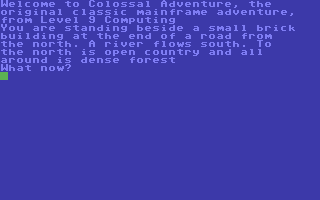
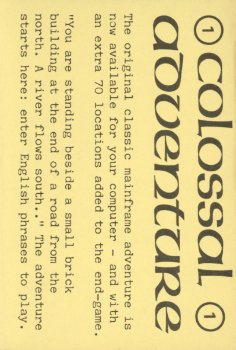
Colossal Adventure is a text adventure based on, and substantially expanded from, Will Crowther and Don Woods’s mainframe game Adventure. After helping a wealthy traveler escape an ambush, the player receives a map leading to the legendary Colossal Cavern. The map is lost shortly before the destination is reached, leaving the adventurer to locate the entrance, explore the underground complex, and recover its hidden wealth. Fifteen treasures must be found and returned to a small building on the surface before the game’s extended final section becomes accessible. The game is presented entirely through text and controlled by typed English commands. The player can travel in cardinal and diagonal directions, enter or leave locations, examine the surroundings, collect and manipulate objects, consult the inventory and score, and speak magical words. The parser accepts short phrases such as “fill the bottle” or “walk into the cave,” identifying the words it recognizes and disregarding many unnecessary ones rather than requiring only rigid two-word commands. Progress can be saved and restored. The adventure contains roughly 200 locations, including forests, rivers, buildings, winding passages, halls, pits, chasms, underground streams, mazes, and chambers reached through magical transportation. Much of the initial cavern reproduces the creatures, treasures, locations, and puzzles of the original Adventure, although Level 9 moved one treasure and concealed an essential object to prevent experienced players from relying entirely on their previous knowledge. Completing the treasure hunt opens a new endgame containing more than 70 additional locations created for this version. Inventory is limited to four objects, requiring useful equipment and treasures to be transported in stages. A lamp illuminates dark passages but has a finite battery supply, while keys, bottles, food, a cage, a rod, an axe, and other items have multiple uses. Puzzles involve navigating mazes, discovering magic words, crossing chasms, opening blocked routes, transporting fragile or heavy treasures, and determining how animals and objects interact. Hostile dwarves appear unpredictably and throw axes, while a pirate may steal treasures and conceal them elsewhere in the cave. Other obstacles include a snake, dragon, bear, troll, clam, and rapidly growing plant. Points are awarded for entering the cavern, discovering treasures, and returning them to the surface building, where they receive their full value. Death reduces the score, while additional bonuses reward particular discoveries and completing the adventure without relying on save and restore. Finding all fifteen treasures automatically begins the expanded endgame, which changes the objective from collecting valuables to surviving a deeper network of caverns and dungeons, rescuing several groups of elves, recovering their crown jewels, and escaping from a growing underground disaster. The maximum possible score is 1,100 points. The Nascom release is the original version. Level 9’s compact A-code system allowed the same game data to be used across multiple computers with platform-specific interpreters. Colossal Adventure was later revised and rereleased with Adventure Quest and Dungeon Adventure as part of the Jewels of Darkness compilation, which added static graphics and other presentation changes.
Description and score courtesy of MobyGames ↗